
Taking Care of Yourself After Baby Arrives: A Postpartum Mental Health Support Plan

There’s a lot of preparation that goes into bringing baby home.
You plan for the nursery.
You gather the essentials.
You learn about feeding, sleep, and what to expect in those early weeks.
But one piece often gets overlooked:
Taking care of yourself.
The postpartum period is a major transition—physically, emotionally, and mentally.
Even when it’s wanted, even when it’s joyful, even when everything is “going well”… it can still feel overwhelming.
Days can blur together.
Sleep is disrupted.
Your body is recovering.
Your identity is shifting.
And suddenly, you’re responsible for a tiny human who depends on you for everything.
A lot of people assume they’ll know if they’re struggling.
But more often, it’s quieter than that.
It might look like:
Feeling more overwhelmed than you expected
Being more irritable or on edge
Having a hard time slowing your thoughts down
Feeling disconnected from yourself or others
Just getting through the day, one task at a time
Nothing dramatic. Just… something feels off.
Why It Helps to Have a Plan Before You Need One
When you’re in the middle of those early postpartum days after baby arrives, it can be really hard to think clearly about what you need to take care of yourself.
That’s why having something simple, visible, and easy to return to can make a difference.
Not a rigid routine.
Not a long list of things you “should” be doing.
Just a gentle guide you can come back to when things feel overwhelming.
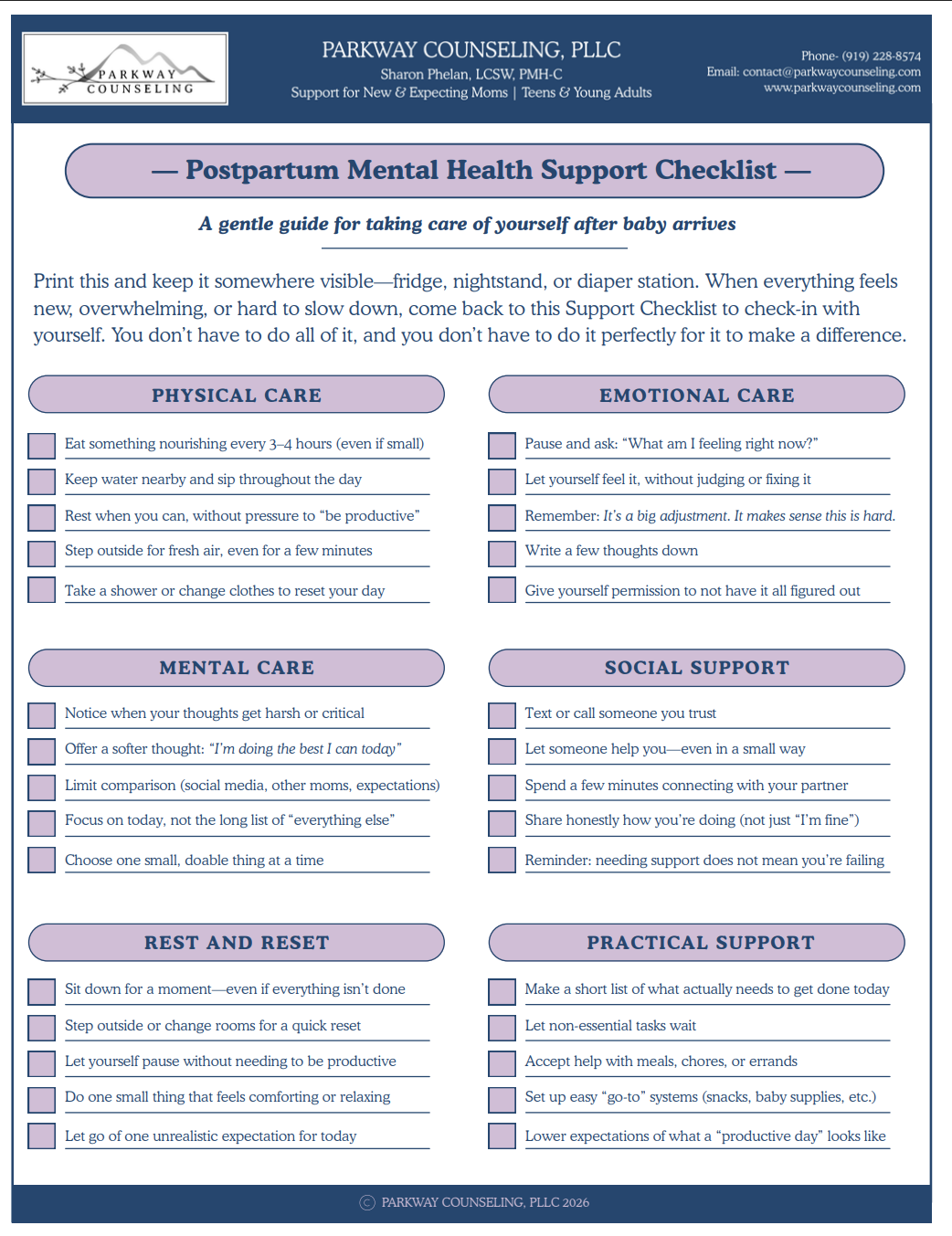
Postpartum Mental Health Support Checklist
I’ve created a one-page Postpartum Mental Health Support Checklist—a simple, practical tool you can keep nearby and return to as needed.
It includes small, realistic ways to support yourself across:
physical care
emotional wellbeing
thoughts and mental load
connection and support
grounding and rest
and reducing the day-to-day mental load
You don’t have to do all of it.
You don’t have to do any of it perfectly.
Even one small moment of care can make a difference.
👉 [Download the Postpartum Mental Health Support Checklist]
(Print it, keep it somewhere visible, and come back to it when you need it.)
You are not alone
If you find yourself feeling persistently overwhelmed, anxious, low, or unlike yourself, it may be a sign that you could benefit from additional support.
And that support doesn’t have to wait until things feel “bad enough.”
Therapy can be a space to:
process what you’re experiencing
feel understood and supported
make sense of the emotional shifts that come with this stage
and develop tools that actually fit your life right now
There’s no perfect way to do this.
There’s no version of postpartum where everything feels easy and intuitive all the time.
But there are ways to feel more supported, more grounded, and more like yourself again.
And sometimes, it starts with something as simple as pausing and asking: What do I need right now?